
Digital ID could become a foundation for South Africa's next phase of digital services
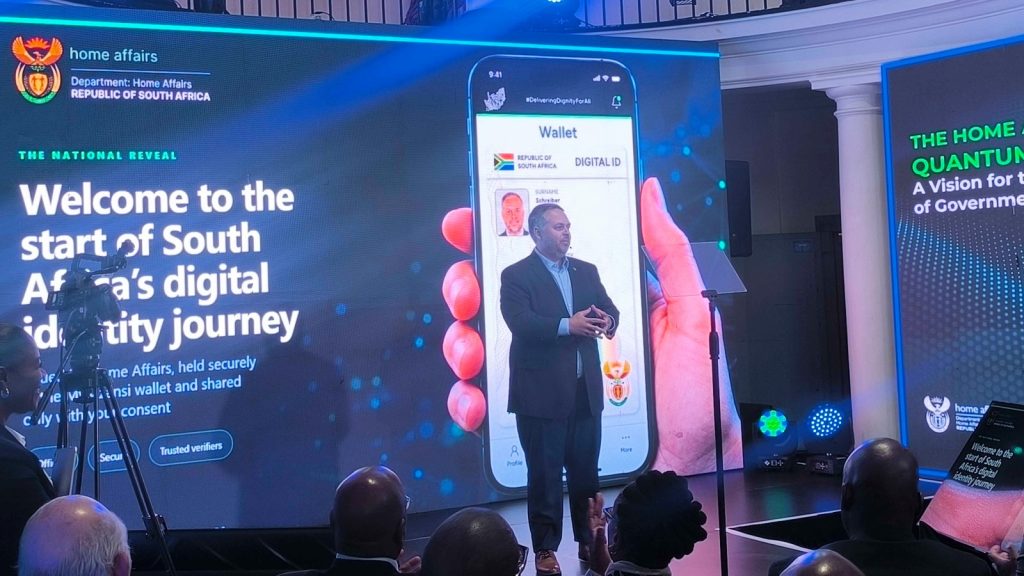
Leon Schreiber, South Africa’s Home Affairs Minister
South Africa's digital identity programme is entering a new phase, but the most significant question may not be what happens to the country's green identity book.
It is what happens after it.
The Department of Home Affairs has demonstrated a working digital identity credential linked to the population register, while setting March 31 2028 as the date on which the green barcoded ID book will cease to be recognised as a valid identity document.
The transition has already attracted attention because of the scale involved. Home Affairs says about 14.7-million citizens and permanent residents still rely exclusively on the green ID book.
But the more consequential development is the possibility that government identity infrastructure could become a foundation on which other digital services are built.
That would shift the conversation from replacing an identity document to creating a common mechanism for establishing who someone is in a digital transaction.
Identity as infrastructure
Identity verification is an often invisible part of the digital economy.
Opening a bank account, applying for insurance, registering for a government service or completing certain financial transactions can all require an organisation to establish the identity of the person on the other side of the screen.
Today, those processes are frequently handled through combinations of documents, databases, passwords, biometrics and separate verification services.
A government-issued digital credential creates the possibility of a more standardised approach.
The technology does not, by itself, solve the problem. The larger opportunity lies in whether institutions can securely use the credential within their own systems.
This is where the programme could become economically significant.
The private sector opportunity
South Africa already has a sophisticated financial services industry and a rapidly developing digital economy.
Banks and fintech companies have invested heavily in digital onboarding, fraud prevention and remote customer verification.
A trusted digital identity layer could potentially reduce some of the friction involved in those processes.
The opportunity extends beyond banking.
Insurance companies, telecommunications providers, healthcare organisations, online marketplaces and other businesses all need ways to establish the identity of customers.
If a common identity standard can be adopted across sectors, businesses could spend less time building parallel mechanisms for proving identity and more time developing the services that sit on top of them.
That would require clear rules around access, liability, consent and data sharing.
It would also require government infrastructure to operate with the reliability and security expected of critical private-sector systems.
The real test is interoperability
The success of Digital ID will therefore depend partly on what happens outside Home Affairs.
A digital credential that can only be used within government will have a narrower economic impact than one that can be securely verified across multiple sectors.
That raises a question of interoperability.
Banks, healthcare providers, insurers and technology companies operate different systems and have different regulatory obligations. Connecting them to a common identity framework requires technical standards as well as legal clarity.
It also requires agreement over who is responsible when something goes wrong.
If a digital identity is compromised, incorrectly verified or used without proper authorisation, accountability cannot be ambiguous.
These questions will become increasingly important as more services move online.
Digital inclusion remains the counterweight
There is another issue that could determine whether the programme delivers broad economic benefits: access.
South Africa's digital economy remains uneven.
Not every citizen has a smartphone, reliable connectivity or the confidence to navigate digital services independently.
For that reason, digital identity cannot simply become a replacement for physical identification overnight.
Home Affairs has indicated that the physical Smart ID card will remain available and that use of the digital credential will be voluntary.
That provides an important transition mechanism.
But the longer-term challenge will be ensuring that digital government expands access rather than creating another divide between citizens who are digitally connected and those who are not.
Trust will be the most valuable feature
Technology will not determine whether South Africans adopt Digital ID. Trust will.
A digital identity system potentially concentrates a significant amount of value around the ability to prove who a person is.
That makes cybersecurity and data governance central to the programme rather than secondary considerations.
The digital identity regulations published earlier this year provide for a credential that can be presented through technologies including near-field communication, Bluetooth and QR codes, with cryptographic protections built into the credential.
The system's design will therefore matter as much as the user experience.
Citizens need to know what information is being shared, with whom it is being shared and when it has been accessed.
Businesses need clarity on their responsibilities.
And government needs the institutional capacity to respond when the system is abused.
The bigger opportunity
South Africa has spent years digitising individual services.
The next stage could be about connecting them.
Digital identity could provide one of the pieces required to do that, giving citizens a more consistent way to authenticate themselves across different platforms.
That could eventually support more efficient government administration and make it easier for businesses to build digital services around trusted identity verification.
But that outcome is not guaranteed.
The technology demonstrated by Home Affairs is an important step. Turning it into widely used national infrastructure will require interoperability, investment, security, regulation and public confidence.
The green ID book may have a defined end date.
The more important deadline, however, will be whether South Africa can use the transition to build an identity system capable of supporting the next generation of its digital economy.